
The latest buzz on the Glowbugs mailing list is about the sale of a Weskit BN-1. This rig, apparently sold by Western Radio of Kearney, NE is a one- or two-tube “Novice transmitter/receiver.” It originally sold in kit form for $14.95, assembled and test $19.95.
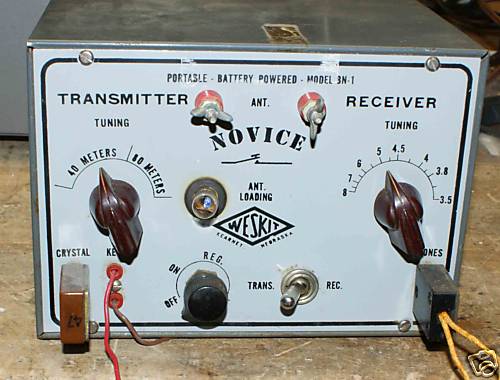
Sheldon, KC0CW, actually has a very nice writeup, which includes a schematic, about this radio. In part, he writes:
The Weskit transmitter-receiver was made by Western Radio (a.k.a. Western Electronics) of Kearney, Nebraska, around the 1956/1957 time period. It is an extremely simple rig, using only a single 7 pin miniature type 3A5 tube. This dual triode tube, which typically serves as a push-pull audio output tube in battery powered portable receivers, performs the transmit function with one triode, and the receive functions with the other. The front panel as shown above, is made of thin sheet metal, with a rather attractive gray paint job with red screen printed markings. The sides, top, and bottom of the box are made of a plastic impregnated cardboard, while the back of the unit remains open.
The transmitter is a modified Pierce crystal controlled oscillator on the 80 or 40 meter amateur bands. The L-C tuned plate tank circuit is link coupled to the antenna, and a type 1843 incandescent lamp in the antenna circuit is used as a tuning indicator. After tuning, the lamp is to be replaced with a type 41 lamp to reduce resistive losses. Power input can be as much as 5 watts with 180 volt supply, however the instructions suggest plate supply voltages as low as 45 volts, with “nominal” operation at 90 volts, with about 1 to 1.5 watts input. Snap on clips are provided for connection to dry cell batteries for high voltage, and a single D-cell battery holder is provided for the filament supply. Switching from transmit to receive applies filament power to only the half of the tube which is in operation.
The receiver is a regenerative type. Regeneration is controlled by a potentiometer across the feedback winding of the tuning coil. Frequency coverage is claimed to be 3400 kc to 8000 kc in the manual, however dial calibration does not go below 3500 kc. Audio output is intended to be fed to high impedance headphones. An optional stage of audio amplification using a type 3V4 tube can be added for operation of a small speaker. A pre-punched hole in the chassis can be utilized for the purpose of mounting the additional tube.
As you can imagine, comments were mixed.
One guy commented, “What a cutsy-kewl rig; and it’s DC powered to boot!”
Another replied, “I remember seeing an ad for the bn-1 when I was a novice and taking offense at the word ‘novice’ emblazoned on the face of the poorest excuse for a lunchbox with knobs I had ever envisioned. I still think that abomination was designed and marketed as a joke. I just cannot imagine any sane ham buying, building, or even wanting something that crude. The folk that brought that thing to market were confusing the words amateur and fool.”
A third said, “The thing with such gizmos, like the one-transistor radios and such that were advertised in the same era magazines, is not to expect miracles for your money. That the ad was the size of a postage stamp should be a clue to any reasonable reader that you were not dealing with the National, Hammarlund, or Hallicrafter class. The thing does work, whether you like it or not. What’s not to work?
“A 1-watt transmitter and a 1 or 2 tube receiver. Granted, the
tuning rate is atrocious, but it was intended to just tune to the frequency of the crystal.
“I prefer to consider such gizmotron products as kind of a friendly joke. The buyer understands, somewhere in his head, not to expect miracles, but you can still hope for them. The company provides a not-expensive learning experience (and I don’t mean learning about being ripped off!! ) and makes a little money as well.”
It does kind of amaze me that someone would actually buy one of these things, but as the last guy says, you could get them to work, and if they weren’t stellar performers, they were cheap, so it was an inexpensive education.
I saw that on Ebay, too, and was kind of intrigued by it. Thanks for the writeup.
Before passing judgment on this rig, I think it’s important to remember that this was an era when Novices had to use crystal-controlled transmitters, *and* a Novice license was non-renewable. You either upgraded before it expired, or you were out of the hobby. People may not have wanted to spend much money on what was bound to be a temporary radio, since after upgrading to General they’d probably want to step up to a VFO rig.
Hi Dan,
One of the comments you made was it was cheap, and wouldn’t matter if it didn’t work too well. In 1956/57 my father was making $4200 a year. That’s less than $12 per day and was as a skilled tradesman in a Ford factory.
I bet that there wern’t too many sold in my neighborhood. Not exactly cheap, when I was sent to the corner store to buy a loaf of bread, 2 pounds of hamburger and a bottle of ketchup with a dollar. My mother was there to collect the change when I returned.
73!
Jim K8ELR
Jim’s comment prompted me to go visit the inflation calculator (http://www.westegg.com/inflation/) and find out how much $14.95 in 1956 would be in today’s dollars. It worked out to $112.87. That does seem like a lot of money for what you get; on the other hand, I can’t think of a new HF transceiver you can buy for under $120 today! Even finding a used one for that price would be tough.
I read the neg comments. What a clod! I found the rig interesting. in fact i have seen a scheatic of it somewhere and contemplated duplicating it. Of Couse inlike the commenter I wasnt born perfect. i sitll have a sense of adventure and curiosity. I still weara wind up watch too. Forty years old without problems and so far has never even needed a battery.
I bought a Weskit BN-1 in the late 1950s after seeing their small ad in the back of an electronics magazine, Popular Electronics if I remember right.
Although I did not have my Novice license yet I got all excited when I connected the battery and an antenna wire and could hear “CHU Dominion Observatory Canada” (the time station).
I remember calling to my mother, “Quick, come up stairs and listen, I can hear Canada on this thing.” The excitement of that moment will be with me forever. I went on to get my Novice, and am now Extra with over 50 years as a ham. But it started with that BN-1, which I still have in the closet. Maybe I’ll take it out tomorrow and fire it up?
The $14.95 price wasn’t all that expensive even back then.
The excitement of hearing CHU for the very first time on that BN-1…PRICELESS !!!
Rodger
W4FM
Great story, Rodger. Thanks for sharing!
I have been a ham since receiving my novice license in April, 1957. If I had known about the BN-1 it might have happened a couple of years earlier. I still strongly support the “KISS” (Keep It Simple Stupid) philosophy. I can only imagine the thrill of the first contact happening with a radio like this, built by me!!
I actually had one of these as a novice back in 1957. It was a piece of junk that ate expensive batteries. Never has a QSO.
Ralph
WB8DQT
It is very interesting reading all the posts by people who have varied opinions about the BN-1.
This was one of the many products designed and built by my father. He owned Western Radio of
Kearney, Nebraska. His name was Paul Beshore and to me and my brothers he was a brilliant man.
He had many reasons for designing the way he did. First among those was he always tried to make the product affordable.
This alone allowed many people to get involved in radio and all that went along with the technology.
I remember that besides the BN-1 and BN-1A Western Radio also marketed the Allband Transceiver (BAB-1), Six Meter Xcvr (BA6-1), Two Meter Xcvr (BA2-1), Citizens Band (C27B) and the All Band Receiver (BR-1), as well as antenna kits etc. Many, many of us (hollow-state types) would love the specs and diagrams of the WESKIT Line… please!
I’d like to have some link about this
Allband Transceiver (BAB-1)
Six Meter Xcvr (BA6-1)
Two Meter Xcvr (BA2-1)
Citizens Band (C27B)
because I never seen one of them.
I’ve been looking into advertising on old magazines archived by google but no joy.
among other things does anyone know if it is true that Western Radio advertised its articles also on QST?
Thanks!
The circuit alone is outstanding. I tube twi functions. Some say simple. Really ? Show me you design then. Oh I see. You have built it yet but….
I operate a single tube Cw station almost every night. I have to have a seperatesingle tube Rx . There is no goood reason . All the parts for both ar e there. I find this ingeneous. I want to make one if I cant find one.
Don VE3LYX
I remember ads for this and similar items from that company in Popular Science, Popular Mechanics and similar magazines.
The first two changes I would have made to it would be phone jacks for key and headphones and a resistor across the filament side of the T/R switch to keep the filament warm but save batteries.
The price was set to appeal to the Boy Scout market.
The Boy Scouts had 1 and 2 tube broadcast radio kits that came in corrigated cardboard boxes that were the radio’s case. You occasionally see them on EBay.
The best radio that I saw for the Boy Scout market was a 2 tube battery and earphone broadcast SUPERHET published as a plan in Popular Mechanics in the early 1950’s.
If I could find the parts I might build one for fun, and maybe a second for 80/40 ham use.
The early novice transmitters were usually had one wire to serve as antenna lead and no PI network.
The Popular Mechanics novice 80M transmitter had a PI network.
The most interesting transmitter from that era was a 1 tube 80 Meter WWII Civil Defence transmitter that John W. Campbell published in Popular Science in 1942 or 1943.
It was mains powered without a transformer using a 117 Volt filament Rectifier Diode-Pentode combination. Add a PI network and you would have had a first class novice transmitter if you didn’t mind the shock hazard.
I recently built a replica of the BN-1 Novice transceiver. As a youngster in the 1950s’ I saw the Western Radio ads in Popular Science and Popular Mechanics and I thought the products were neat. I really liked the BN-1 but not being licensed and no income, it was out of my reach. I would also lust after the all band receiver the Space Rambler and would like to find information and possibly a schematic.
Pictures of my reproduction at:
http://radioremembered.org/images/BN-1/BN-1Front.1.jpg
http://radioremembered.org/images/BN-1/BN-1Front.2.jpg
http://radioremembered.org/images/BN-1/BN-1Rear.jpg
I have the transmitter section working, it puts out a pretty good signal with a little chirp, but haven’t gotten anything out of the receiver section but some squeals and static, so more work to do there.
What a great job!
Darn fine repro, but i’d lose the regen knob for one without the 1970s chrome insert look. What did you use for a cabinet, where’d you get that?
I look forward to finally putting my BN-1 on the air and seeing if i can really get the coast-to-coast range claimed.
This small set is a great memory for me, I purchased one directly from the magazine with money from a month of delivering papers when I was about twelve. My parents had an old radio with AM, FM, SW and I could find the spot on SW that my transmitter was tuned to. Of course, you realize that it was not modulated, only key and the SW receiver was not equipped that well, you could only hear the dash of silence in the normal noise of the SW band when I keyed the thing.
The great thrill for me, was that with a wire attached, I could find many more stations than my Parents Receiver. In fact, at 12 Years old, I thought I had conquered the world, signals were coming from everywhere, in languages that I assumed were Chinese. In fact I believed they could here the CW signal I was sending out to the whole world.
I’m 73 now, have sailed every sea, and been on every continent (including the Antarctic). I am healthy, active and have a rich life. Sometimes, a 3A5 is more than just a dual diode!
Does anyone have a schematic for the BN-1-A? I have one here in good cosmetic condition, but it was pretty poorly wired–cold solder joints, etc. The “A” model was said to have had “improved circuitry.” Mine has several connections that do not agree at all with the published BN-1 circuit and it works extremely poorly–barely at all. I am wondering what the A-model circuit “improvements” were and whether mine incorporates said improvements or is just incorrectly wired. I’m also wondering if a copy of the assembly/operation manual exists out there–I’ve only seen the BN-1 circuit published, but no assembly or operating instructions.
Before I re-wire this BN-1-A model back to BN-1 circuitry, I’d love to know if any of the different wiring in mine is accidental or intended as an “improvement.”
73,
Terry
Terry,
I want to build a clone of the BN-1. Here is a link with a schematic.
http://www.af4k.com/Ham/WeskitBN1.htm
73!
Steve WA3JJT
Terry, K7MPP, some of us would absolutely love to see a photo of your BN-1-A, which seems to a little known variant. Is there some way you could post here or send to my personal email, which I can give as kargo_cult + at + msn dot com
I have a couple BN-1 but not the -A and I am REALLY wondering what any changes were.
As for the list of other transceivers listed, I have looked at a whole lot of magazines over the years, I never saw anything about those. They didn’t exist !
This was my first rig as a novice. I hate to think of how many lawns I mowed that summer to be able to afford that BN-1! The initial cost was one thing for the rig but the batteries were something else! If memory serves I used a big 1.5 “a” battery (like the ones used in the old rural crank phones) and one 90 volt dry cell or you could series two 90s for 180 volts…I went through batteries like they was no tommorow!!
I have one that has a crystal, but lacks a coil and I will be putting it up for sale.
I’ve read all the posts dealing with the BN-1. I own two original BN-1s and they work. Now on how well does it work. I used 45 volts for the plates and 1.5 D battery for the filament. I tuned in some CW signals on 40 meters, they were hard to tune and the regeneration control was very sharp. The antenna coupling is done through the inter-capacitance of the two triodes, so using the transmitter control will bring in the signals.
As far as improving the circuit goes:
1. a fine tuning control for the receiver.
2. a wider Regen control for easy control (increase the control from 2.5 k to 20k and span the feedback coil).
3. try different values for the grid leak (standard is 100pf and 2.2 meg ohms ).
Bottom line, does it work as good as a FT-817…NO! But it does work.
73 de Gary,KF9CM
I remember seeing the ads for these rigs in my great grandfather’s collection of Popular Mechanics magazines from the 50s. I wondered what these radios were all about and who would use them.
It was the early 60’s and I was only 7 or 8 years old. I never heard of ham radio at that time.
Curiosity about these ads kicked off a lifelong interest in electronics and 50 years in ham radio. I’m closing in on retirement as an RF design engineer and I truly believe that it all started with those magazines and the Western Radio ads.
I never used this rig, but it sounds very typical for a simple rig from the 50’s. Magazines were full of construction projects for single tube crystal controlled transmitters and regenerative receivers. By today’s standards they seem like toys, but it is possible to make some contacts. Incidentally, until I read this thread, I didn’t realize that the BN-1 ran on batteries.
If anyone has a QSO with a BN-1 or a BN-1A please post the results here.
73, Paul
I am EXTREMELY poor at CW, but was born in Kearney Nebraska and that means at some point I need to make a replica of this! It would be nice to see photographs of the back and bottom of original radio.
I have make a replica of a WWII Paraset radio that seems to work just fine, but that one has 3 tubes…
Here is my Paraset replica. Haven’t made a contact with it yet.
http://radioremembered.org/images/Paraset/ParasetTop.1.JPG